
Bioaccumulation and biotransformation are important processes, because they regulate accumulation of chemicals along food chains and they determine the internal
dose. The internal dose is sometimes called biologically relevant dose and refers to the time-course of the chemical's concentration in the organism - that is what can cause toxic
effects.
Variation of toxicokinetics across different species
Toxicokinetics vary greatly across different species:
- Toxicokinetic variation in 15 freshwater arthropod species exposed to the insecticide chlorpyrifos
- Uptake and depuration of pharmaceuticals in aquatic invertebrates
It is particularly intriguing that both studies show great variation not only in bioconcentration or bioaccumulation factors, but also in depuration times and kinetic parameters. As both studies relied on measurement of total 14C as a proxy for internal concentrations it remains open to what extend species specific biotransformation was resposible for those differences (Biotransformation dominated toxicokinetics in G. pulex, see paper above). Hence the focus of recent work is on biotransformation:
- Comparative Toxicokinetics of Organic Microlpollutants in Freshwater Crustaceans
- Significance of Xenobiotic Metabolism for Bioaccumulation Kinetics of Organic Chemicals in Gammarus pulex
In some cases the differences in toxicokinetics alone can explain differences in species' response to toxicants:
Importance of Toxicokinetics for Interspecies Variation in Sensitivity to Chemicals
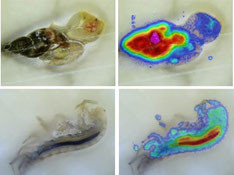
Why do some individuals survive after exposure to chemicals while others die? Either, the tolerance threshold is distributed among the individuals in a population, and its exceedance leads to certain death, or all individuals share the same threshold above which death occurs stochastically. The previously published General Unified Threshold model of Survival (GUTS) established a mathematical relationship between the two assumptions. According to this model stochastic death would result in systematically faster compensation and damage repair mechanisms than individual tolerance. Thus, we face a circular conclusion dilemma because inference about the death mechanism is inherently linked to the speed of damage recovery. We provide empirical evidence that the stochastic death model consistently infers much faster toxicodynamic recovery than the individual tolerance model. Survival data can be explained by either, slower damage recovery and a wider individual tolerance distribution, or faster damage recovery paired with a narrow tolerance distribution. The toxicodynamic model parameters exhibited meaningful patterns in chemical space, which is why we suggest toxicodynamic model parameters as novel phenotypic anchors for in vitro to in vivo toxicity extrapolation. GUTS appears to be a promising refinement of traditional survival curve analysis and dose response models. (Published in Environmental Science & Technology, open access)
Significance of Xenobiotic Metabolism for Bioaccumulation Kinetics of Organic Chemicals in Gammarus pulex.
Abstract: Bioaccumulation and biotransformation are key toxicokinetic processes that modify toxicity of chemicals and sensitivity of organisms. Bioaccumulation kinetics vary greatly among organisms and chemicals; thus, we investigated the influence of biotransformation kinetics on bioaccumulation in a model aquatic invertebrate using fifteen 14C-labeled organic xenobiotics from diverse chemical classes and physicochemical properties (1,2,3-trichlorobenzene, imidacloprid, 4,6-dinitro-o-cresol, ethylacrylate, malathion, chlorpyrifos, aldicarb, carbofuran, carbaryl, 2,4-dichlorophenol, 2,4,5-trichlorophenol, pentachlorophenol, 4-nitrobenzyl-chloride, 2,4-dichloroaniline, and sea-nine (4,5-dichloro-2-octyl-3-isothiazolone)). We detected and identified metabolites using HPLC with UV and radio-detection as well as high resolution mass spectrometry (LTQ-Orbitrap). Kinetics of uptake, biotransformation, and elimination of parent compounds and metabolites were modeled with a first-order one-compartment model. Bioaccumulation factors were calculated for parent compounds and metabolite enrichment factors for metabolites. Out of 19 detected metabolites, we identified seven by standards or accurate mass measurements and two via pathway analysis and analogies to other compounds. 1,2,3-Trichlorobenzene, imidacloprid, and 4,6-dinitro-o-cresol were not biotransformed. Dietary uptake contributed little to overall uptake. Differentiation between parent and metabolites increased accuracy of bioaccumulation parameters compared to total 14C measurements. Biotransformation dominated toxicokinetics and strongly affected internal concentrations of parent compounds and metabolites. Many metabolites reached higher internal concentrations than their parents, characterized by large metabolite enrichment factors.
This paper is open access. Link to journal.Or download pdf here:


Predicting Concentrations of Organic Chemicals in Fish by Using Toxicokinetic Models.
Abstract: Quantification of chemical toxicity continues to be generally based on measured external concentrations. Yet, internal chemical concentrations have been suggested to be a more suitable parameter. To better understand the relationship between the external and internal concentrations of chemicals in fish, and to quantify internal concentrations, we compared three toxicokinetic (TK) models with each other and with literature data of measured concentrations of 39 chemicals. Two one-compartment models, together with the physiologically based toxicokinetic (PBTK) model, in which we improved the treatment of lipids, were used to predict concentrations of organic chemicals in two fish species: rainbow trout (Oncorhynchus mykiss) and fathead minnow (Pimephales promelas). All models predicted the measured internal concentrations in fish within 1 order of magnitude for at least 68% of the chemicals. Furthermore, the PBTK model outperformed the one-compartment models with respect to simulating chemical concentrations in the whole body (at least 88% of internal concentrations were predicted within 1 order of magnitude using the PBTK model). All the models can be used to predict concentrations in different fish species without additional experiments. However, further development of TK models is required for polar, ionizable, and easily biotransformed compounds.
This paper is open access. Link to journal (DOI). Or download pdf here:
Bioaccumulation kinetics of organic xenobiotic pollutants in the freshwater invertebrate Gammarus pulex modelled with prediction intervals.
Abstract: Uptake and elimination rate constants, bioaccumulation factors, and elimination times in the freshwater arthropod Gammarus pulex were measured for 14 organic micropollutants covering a wide range of hydrophobicity (imidacloprid, aldicarb, ethylacrylate, 4,6-dinitro-o-cresol, carbofuran, malathion, 4-nitrobenzyl-chloride, 2,4-dichloroaniline, Sea-Nine, 2,4-dichlorophenol, diazinon, 2,4,5-trichlorophenol, 1,2,3-trichlorobenzene, and hexachlorobenzene; all 14C-labeled). The toxicokinetic parameters were determined by least-square fitting of a one-compartment first-order toxicokinetic model, followed by Markov Chain Monte Carlo parameter estimation. The parameter estimation methods used here account for decreasing aqueous concentrations during the exposure phase or increasing aqueous concentrations during the elimination phase of bioaccumulation experiments. It is not necessary to keep exposure concentrations constant or zero during uptake and elimination, respectively. Neither is it required to achieve steady state during the exposure phase; hence, tests can be shorter. Prediction intervals, which take the between-parameter correlation into account, were calculated for bioaccumulation factors and simulations of internal concentrations under variable exposure. The lipid content of Gammarus pulex was 1.3% of wet weight, consisting of 25% phospholipids and 75% triglycerides. Size-dependent bioaccumulation was observed for eight compounds, although the magnitudes of the relationships were too small to be of practical relevance. Elimination times ranged from 0.45 to 20 d, and bioaccumulation factors ranged from 1.7 to 4,449 L/kg. The identified compounds with unexpectedly long elimination times should be given priority in future studies investigating the biotransformation of these compounds.
Link to paper at journal website. Alternatively download here.